A configuratorbuilt aroundyour product.
Multi-step builds, dependent options, dynamic pricing, shareable configurations, clean order data. Every configurator app can list those features. The difference is whether your customer reaches the end without hesitating.
At a glance
- Typical builds
- Luggage and case builders, apparel configuration, kits and bundles, jewelry
- Capabilities
- Multi-step flows, conditional logic, dynamic pricing, live preview, shareable URLs
- Live example
- ROAM Luggage build-for-you carry-on and custom case quiz — linked below
- Where it lives
- Your Shopify theme, as an editable and manageable section
- Order data
- Structured line-item properties your ops and fulfillment teams can use
- Timeline
- Most builds ship in 14 business days or less after discovery
The short answer
What's the best product configurator for Shopify?
Short answer: every configurator app can list multi-step builds, conditional logic and dynamic pricing — the difference is whether your customer reaches the end without hesitating. GETACUSTOMIZER builds a configurator designed around your product and your customers' decision path, coded into your Shopify theme as an editable section, with structured order data for fulfillment, shipped in 14 business days or less after discovery and owned outright for one fixed fee. Live examples include ROAM Luggage's build-your-own carry-on and custom case quiz.
The case for owning it
Why an owned configurator outperforms an app.
- 01
The decision path is the design problem
Steps, defaults, what's visible on a phone, how price updates are communicated, where a shopper can save or share a build — these are conversion decisions, and they're specific to your product.
- 02
No rule you have to drop
Conditional logic, dimensional pricing, inventory-aware components and exceptions the app model couldn't express all get built, because the model is yours.
- 03
Faster product pages, because nothing extra loads
An app ships a general-purpose bundle to every visitor. A custom build ships only the code your experience actually uses, scoped to the section that needs it — and product-page speed is a conversion input, not a vanity metric.
- 04
You own the asset, not a licence
At launch you get the code, the documentation and a walkthrough. There is no plan to renew, no vendor who can change the terms, and no version of your storefront that stops working because a subscription lapsed.
The honest read
What a configurator has to get right
Shopify's native options cap out at three per product and can't carry free text or uploads, so any real configurator lives outside the variant model. The technical part is solved — apps and custom builds both handle components, logic, and pricing.
What separates them is the decision path: how many steps, what's visible at each one, what happens on a phone, how price changes are communicated, and whether the shopper can share or return to a build. That's a design and conversion problem, and it's product-specific.
Checked September 2026
Side by side
Configurator apps vs. a customizer you own.
Replacing product configurators?
Tell me what your customer has to choose.
One discovery conversation, a fixed price, and an honest answer on whether a build is the right move. No discovery fee.
Not a sales pitch
When an app is the better call
If one of these describes you, I'll tell you to stay where you are. A build that shouldn't exist is bad for both of us.
- You need a configurator live in days and can live with a templated flow.
- Your options are simple enough that a generic step-by-step form genuinely fits.
- You'd prefer a monthly subscription over owning and maintaining code.
Next
How a configurator build runs
- 01
Discovery
Components, dependencies, pricing rules, inventory, fulfillment needs, and the conversion problem you're solving.
- 02
Design to spec
The full flow designed to your brand and approved by you before production code.
- 03
Build, QA, own
Built into your theme as a manageable section, tested across devices, handed over with the code.
Examples
Live in the wild.
Real storefronts running custom customizers. Open any of them and configure a product the way a customer would.
 Jewelry
Club Coastal
Charm necklace builder
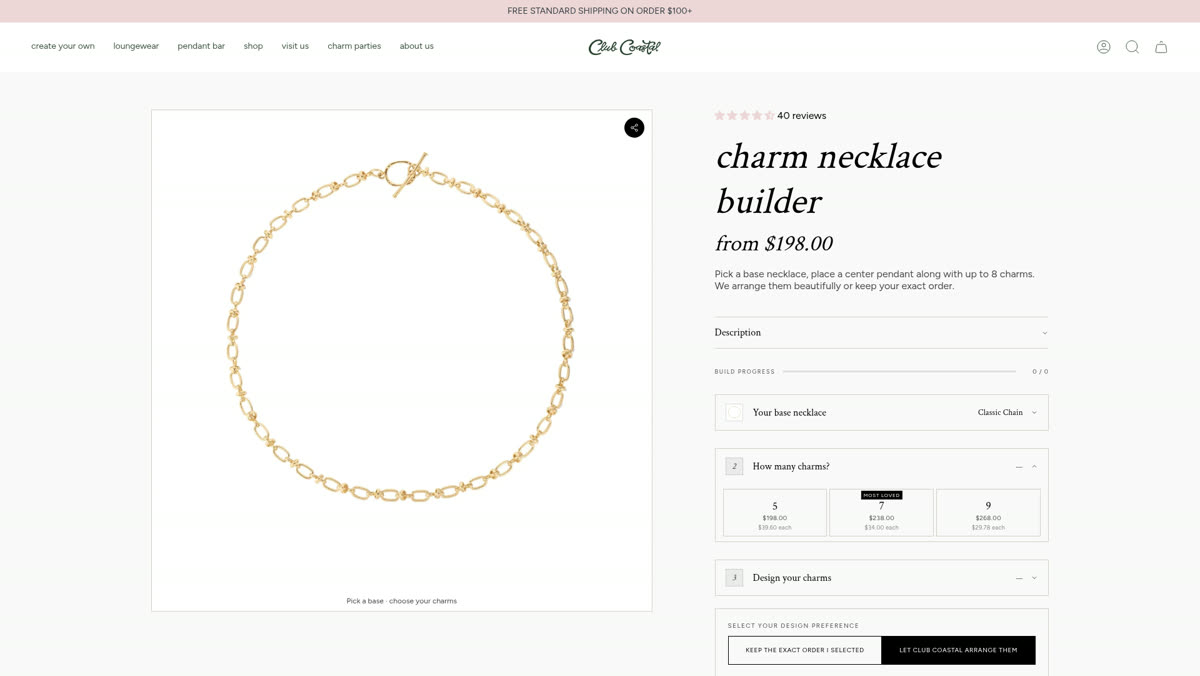
Pick a base chain, place a center pendant, then build up to eight charms — with live pricing per charm count and a choice of arrangement.
 Jewelry
Club Coastal
Pendant bar
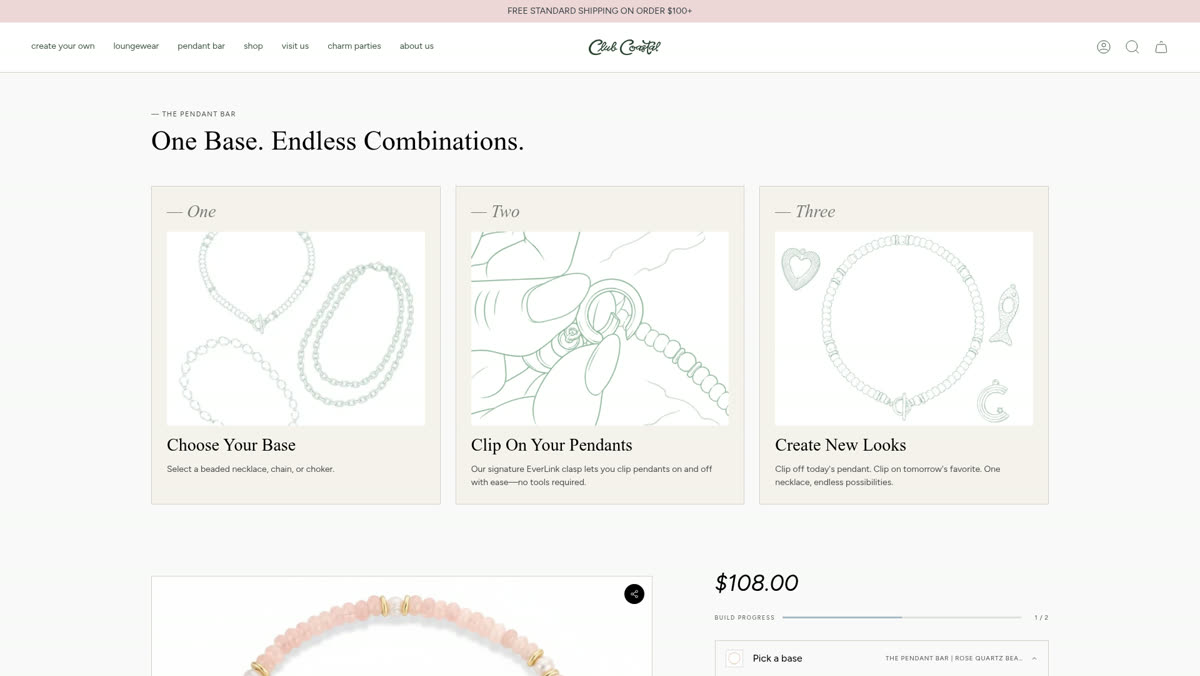
A browsable pendant bar that lets customers mix and match pieces into their own combination before adding to cart.
 Jewelry
And Livy
Design your charm necklace
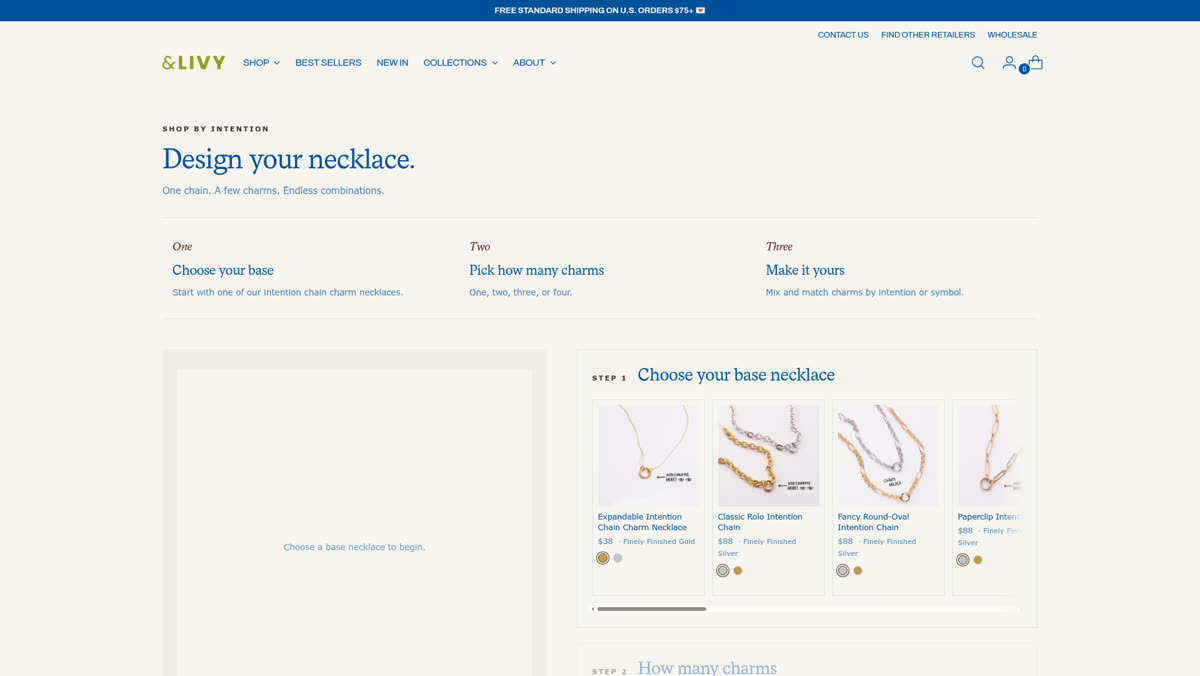
A guided design flow for charm necklaces — chain, placement, and charm selection resolved into a single made-to-order item.
 Luggage
Roam Luggage
Build-for-you carry-on
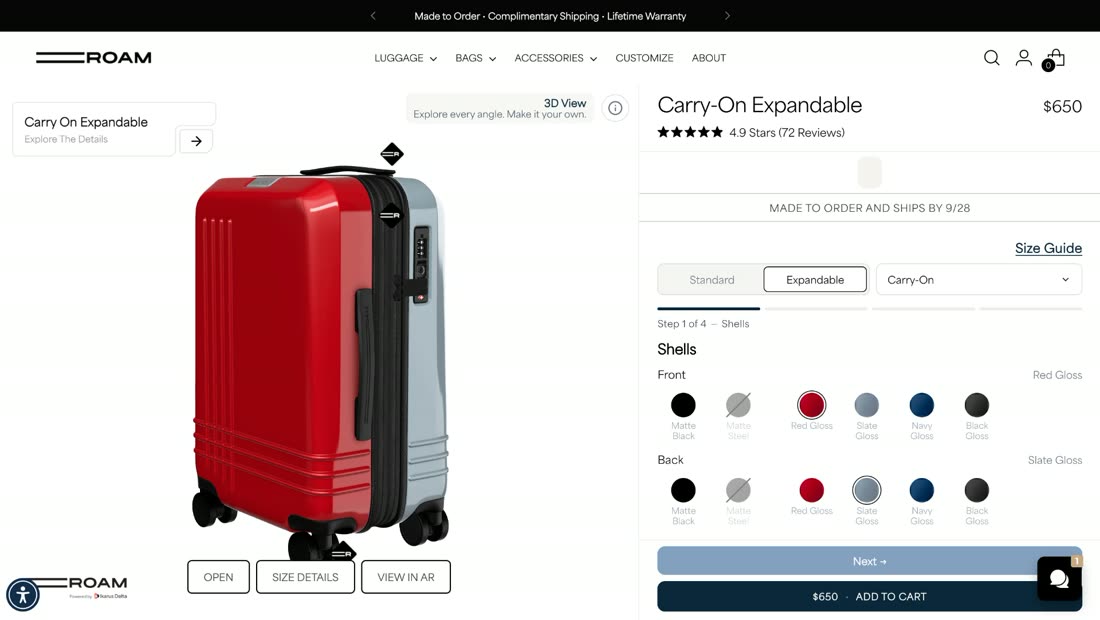
A multi-step configurator for shells, zipper, trim, wheels, binding, and handles — shareable via URL and priced live.
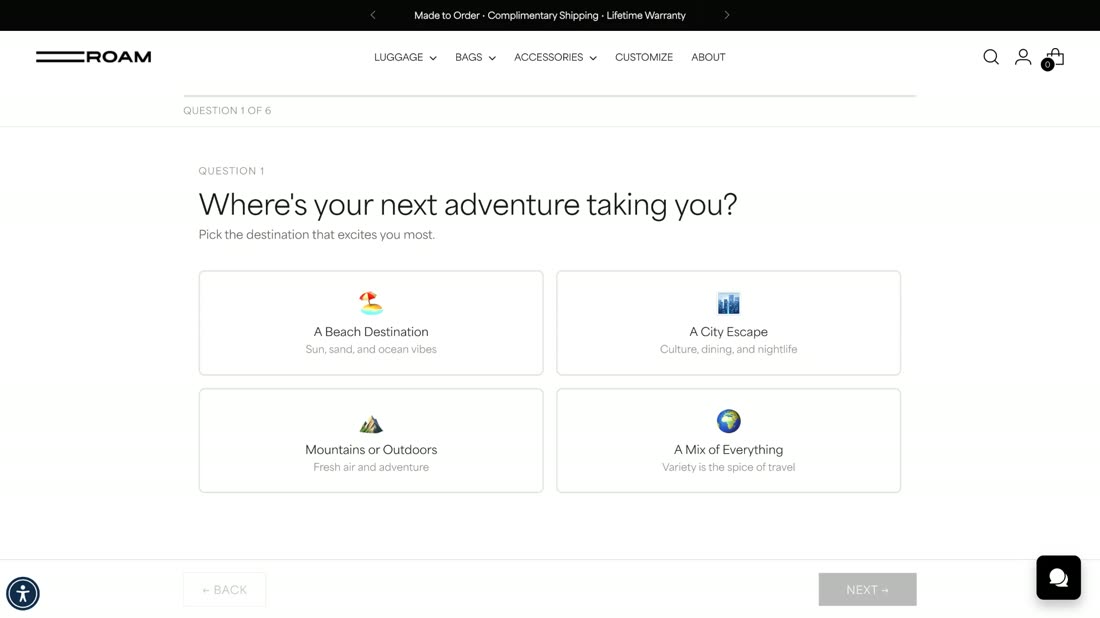 Quiz
Roam Luggage
Custom case quiz
A six-question guided quiz that reads travel style and destination, then routes the shopper to the case configuration that fits.
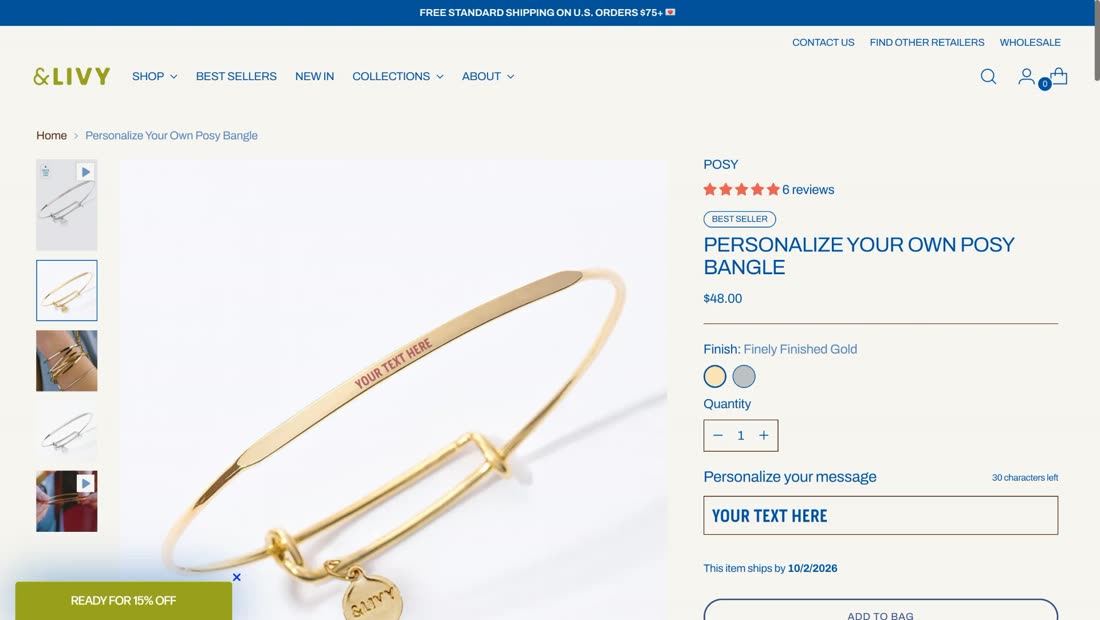 Jewelry
And Livy
Stack builder
Personalized bangles built to stack — finish selection, live engraving preview with a character limit, and made-to-order handling in the theme.
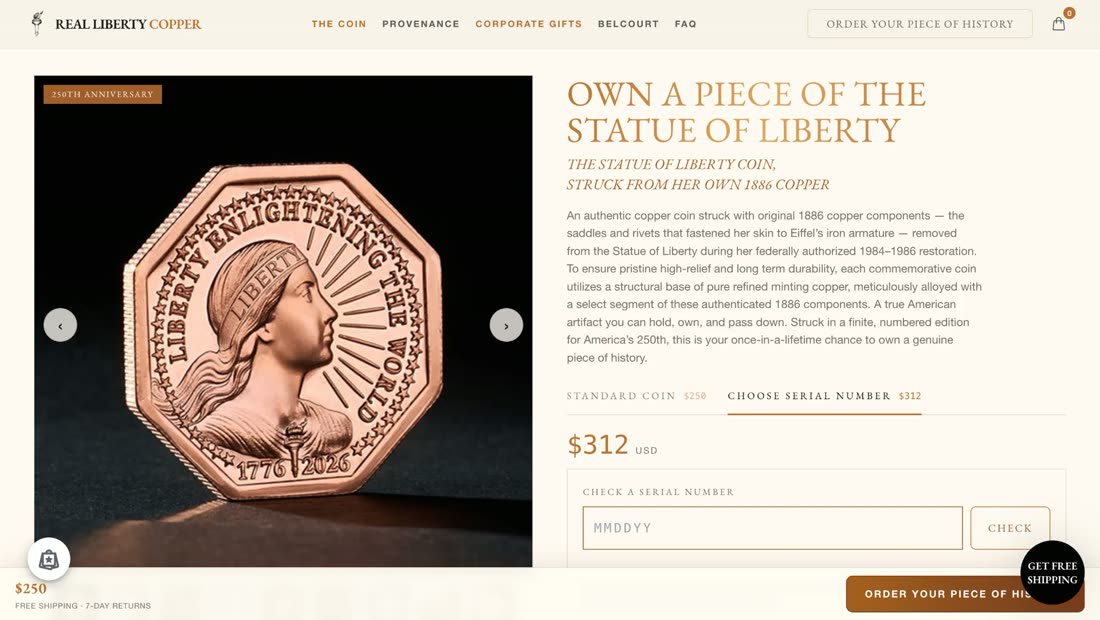 Collectibles
Real Liberty Copper
Custom coin experience
A collector's flow for a numbered edition — standard or choose-your-serial, a serial number lookup, and price switching inside the product page.
Process
The 14-day cycle
Days, not months.
Business days, measured from the end of discovery — not the six-month custom build you've been quoted elsewhere. One person owns strategy, design, and development, so nothing waits in a queue.
- 01Day 0
Discovery
We map your products, options, pricing rules, and the exact path a customer takes to a confident order.
- 02Days 1–4
Design to spec
Interface designed to your brand — not a themed template. You sign off before a line of production code.
- 03Days 5–11
Build
Developed and installed in your theme as an editable, manageable section your team can control.
- 04Days 12–14
QA & launch
Device and browser testing, cart and order-data checks, edge cases, then a controlled launch.
- 05After launch
Handoff
You get the code, documentation, and a walkthrough. It's yours — no license, no subscription.
Questions
About product configurators.
Questions brands ask first
Start a project
Tell me what your customer has to choose.
Send a few details and I'll come back with an honest read: whether a custom customizer is the right move, what it would take, and a realistic timeline. No pitch deck, no discovery fee.
Two short steps. Contact details come last.